5.3. Views, Interactions & Classifier
exaDEM stores most of its bulk per-element data (interactions, driver projection grids,
polyhedron position backups, GPU neighbor-list bookkeeping, …) as owning
Structure-of-Arrays containers, and exposes it to compute kernels through a lightweight,
non-owning View built on top of onika::cuda::span. This page has three parts:
Views – what a
Viewis, as a general pattern used across the codebase.Interactions – the per-interaction structs (
InteractionPair,Interaction,InnerBondInteraction,PlaceholderInteraction), and how to add a field to one.Classifier, ClassifierContainer & ClassifierDispatcher –
Classifier,ClassifierContainerandClassifierDispatcher, the storage and dispatch machinery built on top of both.
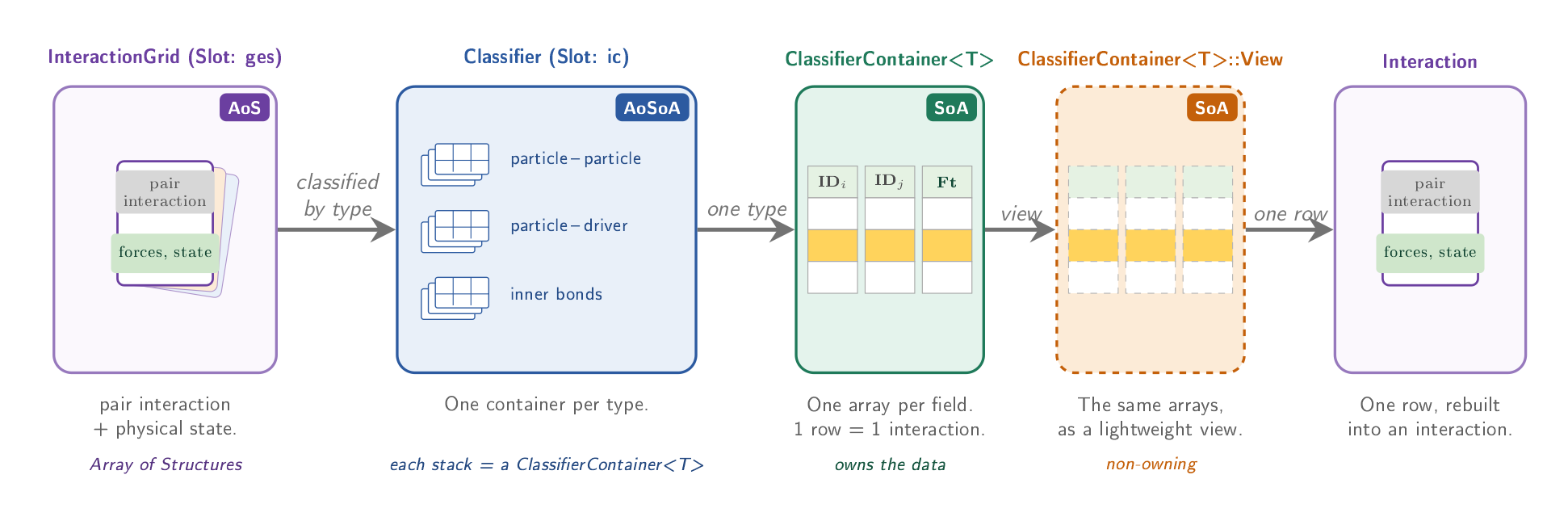
How the classes on this page relate to each other, left to right: individual interactions
(Array-of-Structs) are grouped by type into a Classifier – itself an array of per-type
containers, i.e. an Array-of-Structures-of-Arrays; each type is one ClassifierContainer<T>
(an owning Structure-of-Arrays); a View exposes the same arrays without owning them; and a
single row of a View, once indexed, is rebuilt back into one Interaction (or
InnerBondInteraction).
5.3.1. Views
5.3.1.1. What is a View
View is not a single class but a convention (in exaDEM) followed by several, otherwise unrelated,
owning storage classes across the codebase. A class following it declares a nested struct
View and a .view() method:
the owning class stores its data in
CudaMMVector<T>(one per field, for Structure-of-Arrays layouts) or another owning container,its nested
Viewmirrors the same fields, but each one is anonika::cuda::span<T>– a non-owning{ T* data; size_t size; }pair pointing at the same (CUDA unified) memory,.view()builds aViewfrom the current state of the owning object.
A View is trivially copyable and safe to capture by value into a parallel_for/GPU
kernel functor, unlike the owning object itself. This is the recurring reason the pattern
exists: build the owning storage on the host (resize, fill, …), then hand a cheap,
GPU-callable View of it to the kernel.
Owning class |
|
|---|---|
|
|
|
|
|
|
|
|
|
|
|
|
5.3.1.2. Usage example
The simplest instance of the pattern, DEMBackupData (polyhedron/backup_dem.hpp):
struct DEMBackupData {
onika::memory::CudaMMVector<double> data_;
onika::memory::CudaMMVector<uint32_t> index_map_;
struct View {
onika::cuda::span<double> data_;
onika::cuda::span<uint32_t> index_map_;
};
inline View view() { return View{onika::cuda::make_span(data_), onika::cuda::make_span(index_map_)}; }
};
and how it is consumed: build a View from the owning object, then read/write a field
directly through it, exactly like on the owning CudaMMVector (operator[]/.data()),
just without owning the memory:
int idx = 50;
int shift = 10;
DEMBackupData::View view = backup_dem.view();
view.index_map_[idx] = shift;
double value = view.data_[view.index_map_[idx]];
Note
View and performance: spans are not restrict pointers
5.3.2. Interactions
Independently of how they are stored (see Views / Classifier, ClassifierContainer & ClassifierDispatcher),
interactions come in a small family of C++ structs (exaDEM/interaction/) – the leftmost and
rightmost boxes of the diagram above. Every one of them starts with an InteractionPair pair_,
which holds the topology of the interaction (who is interacting with whom) and is identical
regardless of the kind of interaction; what follows pair_ holds the
kind-specific physical state and differs between a contact and an inner bond.
Struct |
Content |
|---|---|
|
Topology only, common to every kind: |
|
|
|
|
|
|
The kind-specific fields (listed in the table above, e.g. friction on Interaction) are
not plain public members: they are read/written through operator[] with a tag from the
attr namespace, I[attr::NAME], on any Interaction/InnerBondInteraction instance
– for example:
Vec3d f = I[attr::friction];
I[attr::moment] = Vec3d{0, 0, 0};
The same operator[](attr::NAME) also works on a whole ClassifierContainer<IT> or its
View (returning the field’s array instead of a single value) – see Classifier, ClassifierContainer & ClassifierDispatcher.
PlaceholderInteraction is the type-erased form used whenever code needs to hold/move/sort
an interaction without knowing at compile time whether it’s a contact or an inner bond: its
buffer is reinterpreted as the real struct via .as<T>() once the kind is known (from
pair_.type_).
Warning
Because dump/restart files store PlaceholderInteraction as raw bytes, adding, removing,
or reordering fields in Interaction/InnerBondInteraction changes its in-memory layout
and therefore breaks binary compatibility with previously-written dump files containing
interactions.).
5.3.2.1. Adding an attribute in an interaction struct
Interaction, InnerBondInteraction, ClassifierContainer<IT> and
ClassifierContainer<IT>::View do not declare their fields directly: each is generated
from an X-macro field list via the machinery in interaction_decoration.hpp (see the large
“DANGER ZONE” comment at the top of that file for the full set of caveats). In practice, adding
a field to an interaction just means adding one line to one of two lists:
EXADEM_INTERACTION_FIELDS, insrc/interaction/include/exaDEM/interaction/interaction.hpp– backsInteraction(particle-particle and particle-driver contacts).EXADEM_INNER_BOND_FIELDS, insrc/interaction/include/exaDEM/interaction/inner_bond_interaction.hpp– backsInnerBondInteraction(see the worked example below).
#define EXADEM_INTERACTION_FIELDS(X)    \
  X(exanb::Vec3d, friction, 0, NEW_TAG) \
  X(exanb::Vec3d, moment, 1, NEW_TAG)
Append a new line X(TYPE, NAME, INDEX, NEW_TAG), with INDEX equal to the list’s current
length (2 here, since it would become the third field). That’s it: the attr::NAME tag,
the operator[](attr::NAME) accessor, and the matching storage in ClassifierContainer<IT>
and its View are all generated automatically from that one line – nothing else needs a
manual edit.
Use NEW_TAG unless the field already exists in the other list under the same name (like
friction, used by both Interaction and InnerBondInteraction): in that case, write
SHARED_TAG instead, so the name isn’t declared twice.
Danger
INDEX must match the field’s position in the list (0, 1, 2, ...). Nothing checks this
at compile time – a wrong index silently reads/writes the wrong field at runtime.
5.3.2.2. Tutorial: adding a field to InnerBondInteraction
Worked example applying the recipe above: add dissipated_energy (a double accumulating
the energy dissipated by a bond over time) to inner-bond interactions.
Edit the field list, in
exaDEM/interaction/inner_bond_interaction.hpp– append a line withINDEX = 8(the list currently has 8 entries, indices0..``7``):#define EXADEM_INNER_BOND_FIELDS(X) \ X(exanb::Vec3d, friction, 0, SHARED_TAG) \ X(double, en, 1, NEW_TAG) \ X(exanb::Vec3d, tds, 2, NEW_TAG) \ X(double, et, 3, NEW_TAG) \ X(double, dn0, 4, NEW_TAG) \ X(double, weight, 5, NEW_TAG) \ X(RuptureCriteria, criterion, 6, NEW_TAG) \ X(uint8_t, unbroken, 7, NEW_TAG) \ X(double, dissipated_energy, 8, NEW_TAG) // <-- new field, NEW_TAG since it's not reused elsewhere
Extend the explicit initializer list on
InnerBondInteraction(same file) with a default value at the matching position – unlikeInteraction, which just zero-initializes everything, this struct lists a default value for every field by hand.fm_ = { {0, 0, 0}, // friction 0.0, // en {0, 0, 0}, // tds 0.0, // et 0.0, // dn0 1.0, // weight {}, // criterion true, // unbroken 0.0 // dissipated_energy };
Use the field. It is already usable through
operator[](attr::dissipated_energy)onInnerBondInteraction, onClassifierContainer<InnerBond>and on itsView– no further declaration needed. For instance, accumulating it in a fracture-criterion-style kernel (pattern taken fromapply_interface_fracture_criterion.hpp, which already readsinteraction_[attr::en]/interaction_[attr::et]the same way):// per-interaction update, e.g. inside a kernel operating on an InnerBondInteraction& I I[attr::dissipated_energy] += I[attr::en] + I[attr::et]; // or, batched over a whole View (as apply_interface_fracture_criterion.hpp does for en/et): double* __restrict__ diss = interactions_[attr::dissipated_energy].data(); diss[idx] += en[idx] + et[idx];
Danger
This will very likely break reading previously-written restart/dump files
5.3.3. Classifier, ClassifierContainer & ClassifierDispatcher
exaDEM stores every interaction (particle-particle contact, particle-driver contact, or
inner bond) as a row of a per-type Structure-of-Arrays container – the three middle boxes of
the diagram above: one ClassifierContainer<IT> per interaction type id, owned by a
Classifier, exposed to kernels through ClassifierContainer<IT>::View (an instance of the
View pattern described above), and routed to the right compile-time InteractionType at
runtime by ClassifierDispatcher. Its fields are the same ones described in
Interactions above – see that section for how to add one.
5.3.3.1. ClassifierContainer
The ClassifierContainer<IT> class is the owning
storage for one interaction type id (e.g. VertexFace) of a given InteractionType
category (IT). It is explicitly specialized per InteractionType because each category backs a
different per-interaction struct and therefore a different field set:
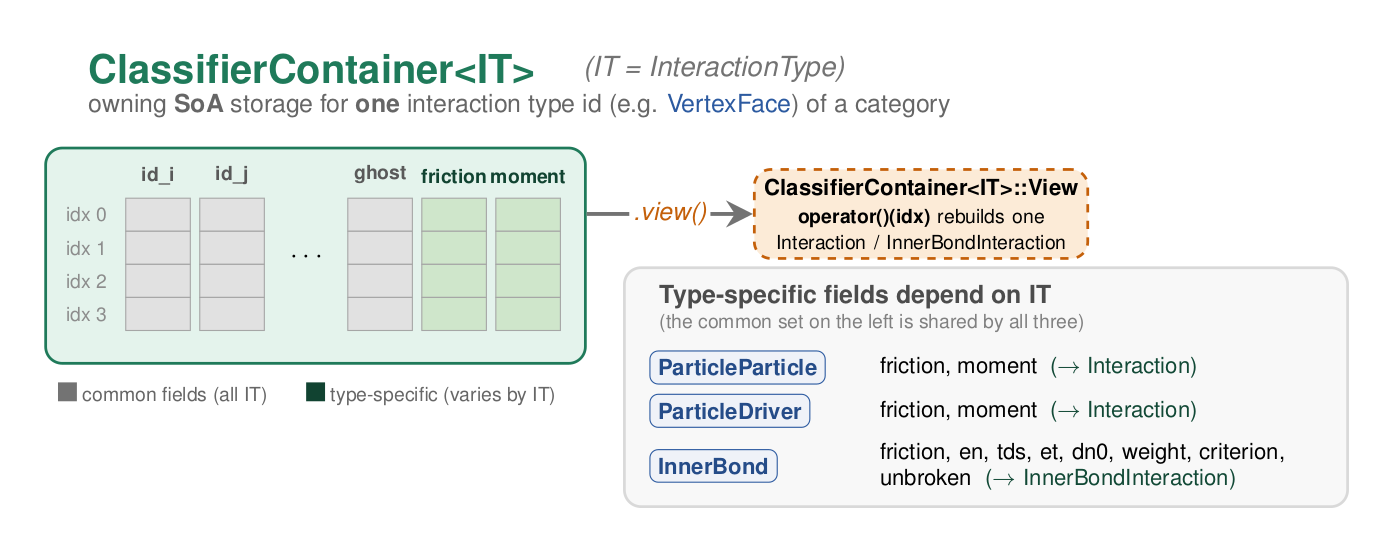
The common fields (grey) are shared by all three specializations; the type-specific fields
(green) depend on IT – friction/moment for ParticleParticle/ParticleDriver
(backing Interaction), or the larger inner-bond field set for InnerBond (backing
InnerBondInteraction).
|
Common fields (all specializations) |
Type-specific fields |
|---|---|---|
|
|
|
|
(same as above) |
|
|
(same as above) |
|
Each field is accessed as one array via container[attr::field_name]. To build a container,
resize/clear it and fill it with insert/copy from a
std::vector<PlaceholderInteraction>; to consume it in a kernel, call view() to get a
ClassifierContainer<IT>::View (see Views).
5.3.3.2. Classifier
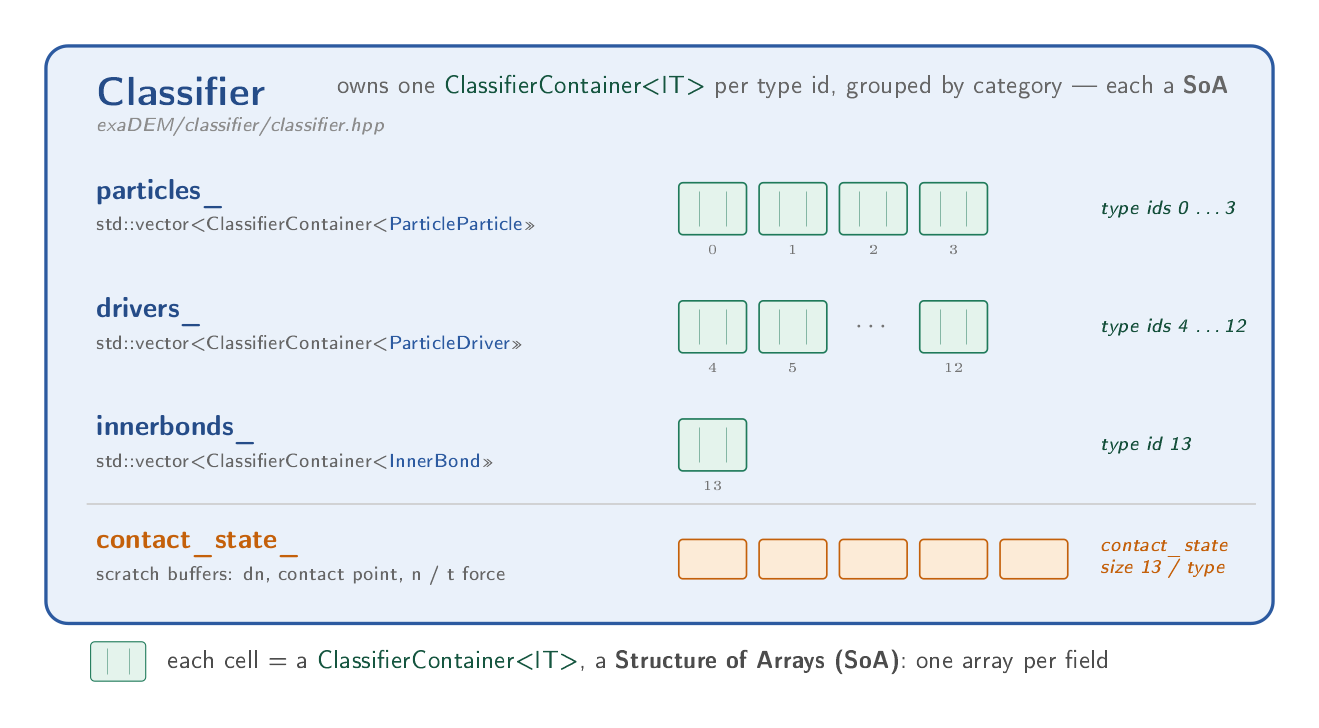
Classifier owns one ClassifierContainer<IT> per interaction type id, grouped into three std::vector``s by category + one buffer for contact-law ``scratch data:
particles_: type ids 0…3, one per polyhedron feature pair: vertex-vertex, vertex-edge, vertex-face, edge-edge,std::vector<ClassifierContainer<ParticleParticle>>.drivers_: type ids 4…12, one per particle/driver feature pair,std::vector<ClassifierContainer<ParticleDriver>>.innerbonds_, type id 13,std::vector<ClassifierContainer<InnerBond>>.contact_state_: per-type scratch buffers for quantities computed by the contact law but not persisted on the interaction itself (overlapdn, contact point, normal/tangential force).
Given a runtime type id (0… NTypes-1), get_data<IT>(typeID) /
get_info<IT>(typeID) return the matching ClassifierContainer<IT>& (and its size for the
latter); IT, for InteractionType, must be known at compile time and is usually fixed by the calling template.
for_all_interactions(classifier, func, ...) loops over
every type id and calls func once per non-empty container.
5.3.3.3. ClassifierDispatcher
Motivation: there is a mismatch to resolve here. Compute kernels are templated on the compile-time
InteractionType IT – the compiler needs to know, at compile time, whether it’s generating
code for Interaction or InnerBondInteraction (and their respective View). But at
runtime, all the code actually has is a plain integer type id, read off the particle’s neighbor
list – not a C++ type.
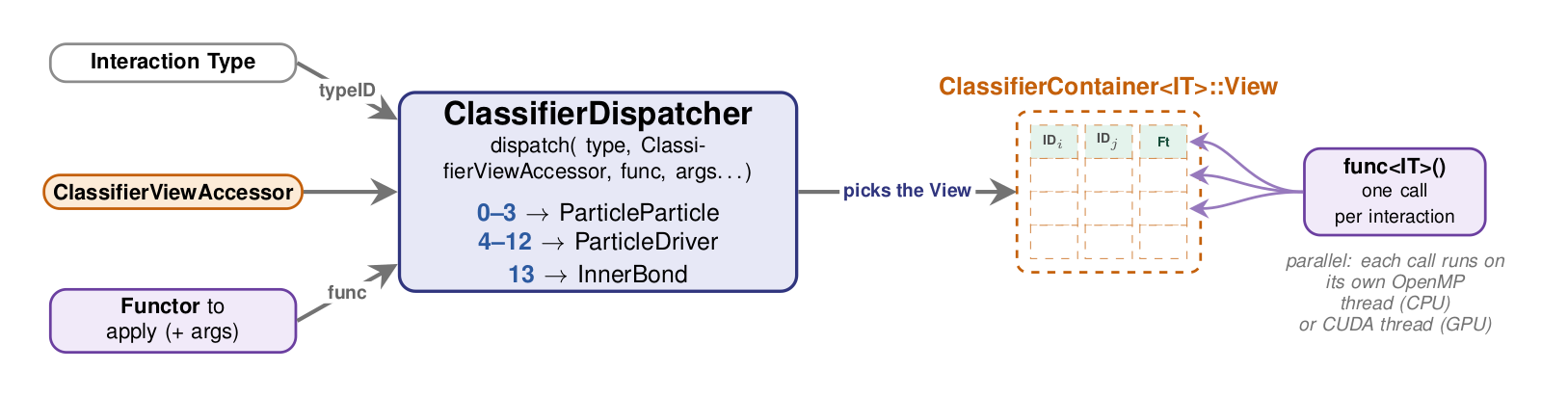
ClassifierDispatcher::dispatch turns a runtime type id back into the matching
ClassifierContainer<IT>::View, and calls func<IT>() once per interaction of that type
– in parallel, each call running on its own OpenMP thread (CPU) or CUDA thread (GPU).
The ClassifierDispatcher (aliased IDispatcher for the 3 real categories) closes that gap, as shown above: given the runtime
type id, it works out which of Types... it belongs to and calls
func.template operator()<IT>(...) with that one, specific, compile-time IT – so from
that call onward, inside func, the code is fully statically typed again. Along with IT,
it passes func the matching View, looked up through a ClassifierViewAccessor: a
plain-pointer, GPU-callable lookup into 3 arrays of View, one per category.
ClassifierViewStorage wrappers(classifier);
ClassifierViewAccessor accessor = wrappers.accessor();
FunctorType func;
int typeID = 3;

IDispatcher::dispatch(typeID, accessor, func, args...);