Defining regions
Named regions are defined once via particle_regions, then consumed elsewhere — see Restricting particle generation and Tracking particles in regions for how they're used afterward.
particle_regions
particle_regions:
  - <name>:
      id_range: [<int>, <int>]
      bounds: [[<float>, <float>, <float>], [<float>, <float>, <float>]]
      quadric:
        shape: <string>
        transform: [ { scale: [<float>, <float>, <float>] }, { translate: [<float>, <float>, <float>] } ]
id_range:  2 ints, default whole id range        # Particle-id range [start, end), end exclusive.
bounds:    AABB, default unbounded               # Axis-aligned box, in physical space.
quadric:   shape/matrix + transform, optional    # A canonical shape or a raw 4x4 matrix, optionally transformed — see below.
Each region can combine, in any subset, an id_range, a bounds box and a quadric shape; a point is inside the region only if it satisfies every criterion that was set. None of the three is required — a region with none of them matches the entire domain and every particle id.
Warning
All regions are defined in the physical space, not in the grid space. This is to be taken into account when creating regions, especially when dealing with triclinic physical domains.
Regions are not periodic
Region membership (bounds and quadric) is a plain geometric test against a particle's raw position — it has no awareness of the domain's periodic boundary conditions. A region that is meant to straddle a periodic boundary will not wrap around: it is simply cut off at the domain's edge, and particles on the other side of that boundary are excluded even if they'd be adjacent under periodicity. If you need a region that spans a periodic edge, define it as the union (or) of the two pieces on either side instead.
Every quadric-based region below — no matter which shape keyword it uses, or a raw matrix — is really just one symmetric 4×4 matrix \(Q\) tested against the point's position.
The quadric equation behind every quadric-based region
A point \(\mathbf{r}=(x,y,z)\) is inside a quadric region if, in homogeneous coordinates \(\mathbf{r_h}=(x,y,z,1)\), it satisfies:
where \(Q\) is a symmetric 4×4 matrix — exactly the 16 coefficients you can provide directly via quadric.matrix. Expanded, this is the general quadric surface equation:
Each named shape keyword is just a canonical, pre-built choice of \(Q\):
sphere: \(Q = \mathrm{diag}(1,1,1,-1)\) → \(x^2+y^2+z^2 \le 1\) (unit sphere)cylx/cyly/cylz: same, but the diagonal term for the cylinder's own axis is zeroed instead of squared — e.g.cylx: \(Q=\mathrm{diag}(0,1,1,-1)\) → \(y^2+z^2 \le 1\) (infinite unit cylinder along x)conex/coney/conez: same idea, with that axis' diagonal term negated and \(Q_{44}=0\) — e.g.conex: \(Q=\mathrm{diag}(-1,1,1,0)\) → \(y^2+z^2 \le x^2\) (double cone along x)planex/planey/planez, orplane: [Nx,Ny,Nz,D]: only the terms coupling \(x,y,z\) to the homogeneous1are non-zero, giving back the ordinary plane equation \(N_x x + N_y y + N_z z + D \le 0\)
transform's scale/translate/xrot/yrot/zrot operations don't move the point — they instead conjugate \(Q\) by the transform's own matrix \(T\): \(Q' = (T^{-1})^T \, Q \, T^{-1}\). This is exactly what lets a single canonical unit shape be scaled, rotated and translated into place instead of needing a different \(Q\) for every size/position. Providing quadric.matrix directly skips the canonical-shape step and lets you specify \(Q\)'s 16 coefficients yourself — transform still applies on top of it the same way.
Individual regions
Parallelepiped
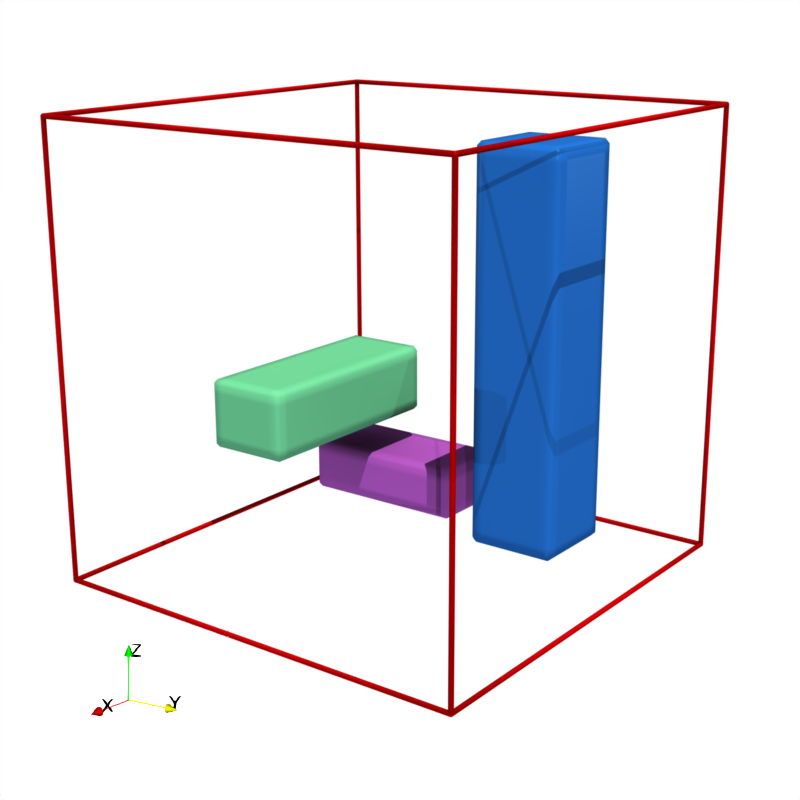
particle_regions:
  - B1:
      bounds: [ [ 10, 10, 5], [30, 50, 15] ]
  - B2:
      bounds: [ [ 15, 10, 25], [65,30,40] ]
  - B3:
      bounds: [ [ 30, 70, 10], [50, 90, 95] ]
boundsPlane-quadrics
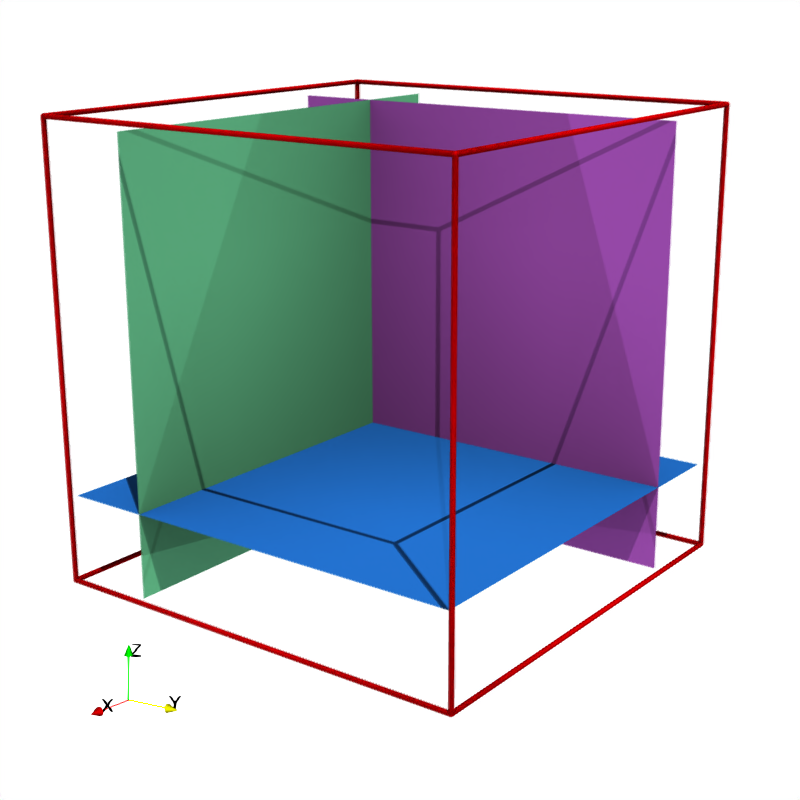
particle_regions:
  - P1:
      quadric:
        shape: { plane: [ 1, 0, 0, 0 ] }
        transform: { translate: [ 20, 0, 0 ] }
  - P2:
      quadric:
        shape: { plane: [ 0, 1, 0, 0 ] }
        transform: { translate: [ 0, 20, 0 ] }
  - P3:
      quadric:
        shape: { plane: [ 0, 0, 1, 0 ] }
        transform: { translate: [ 0, 0, 20 ] }
plane shapesCylinder-quadrics
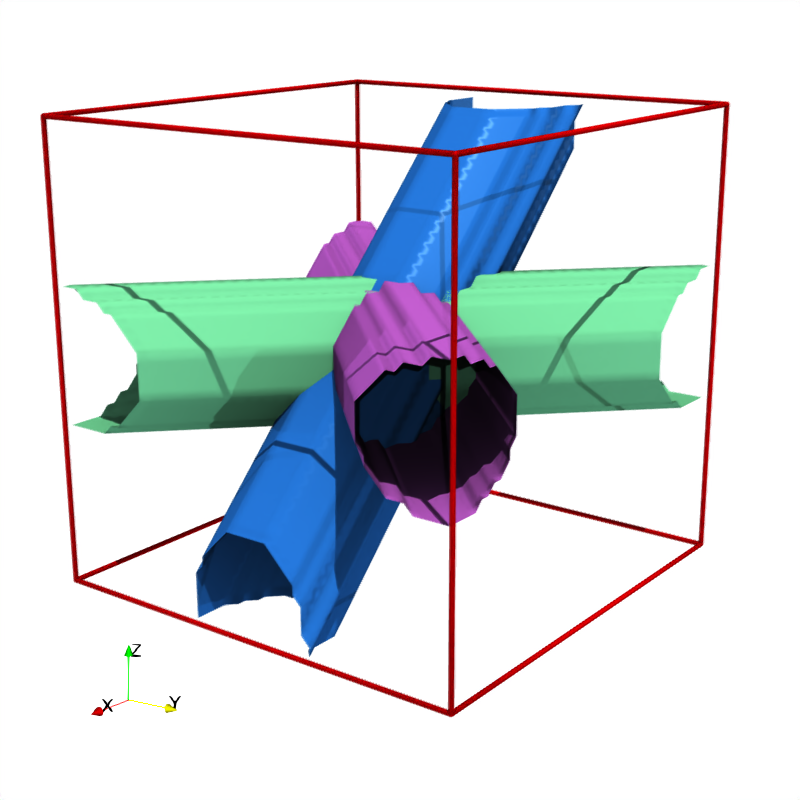
particle_regions:
  - P1:
      quadric:
        shape: cylx
        transform:
          - scale: [ -1, 15, 15 ]
          - zrot: pi/4.
          - translate: [ 50, 50, 50 ]
  - P2:
      quadric:
        shape: cyly
        transform:
          - scale: [ 15, -1, 15 ]
          - zrot: pi/4.
          - translate: [ 50, 50, 50 ]
  - P3:
      quadric:
        shape: cylz
        transform:
          - scale: [ 15, 15, -1 ]
          - yrot: -pi/4.
          - translate: [ 50, 50, 50 ]
cylx/cyly/cylz shapesEllipsoid-quadrics
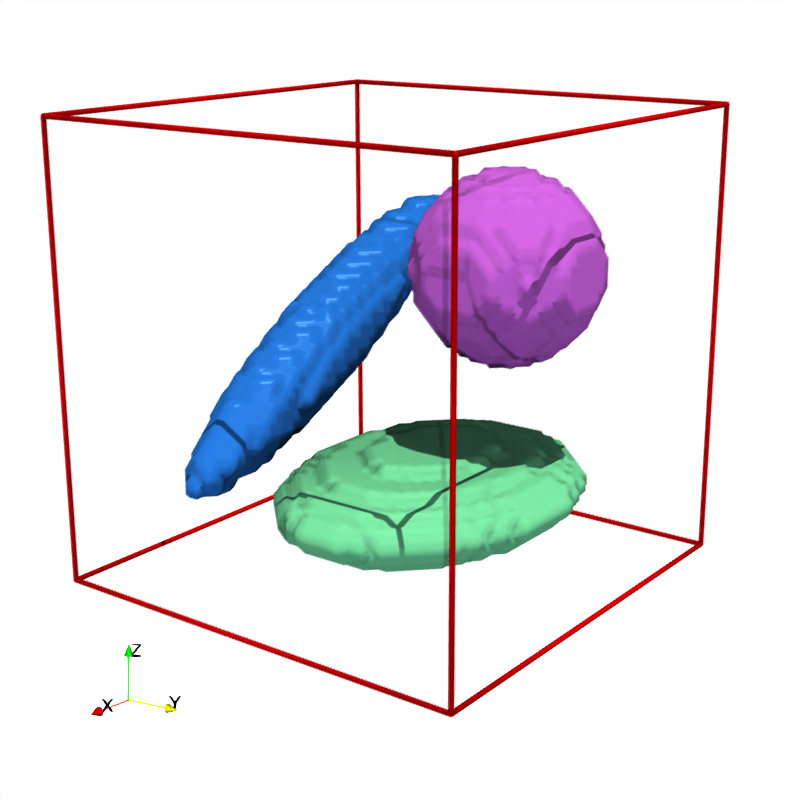
particle_regions:
  - S1:
      quadric:
        shape: sphere
        transform:
          - scale: [ 20, 20, 20 ]
          - translate: [ 45, 75, 70 ]
  - S2:
      quadric:
        shape: sphere
        transform:
          - scale: [ 40, 30, 10 ]
          - translate: [ 50, 60, 20 ]
  - S3:
      quadric:
        shape: sphere
        transform:
          - scale: [ 50, 10, 10 ]
          - yrot: pi/6.
          - translate: [ 50, 30, 50 ]
sphere shapesCone-quadric
particle_regions:
  - CO1:
      quadric:
        shape: conex
        transform:
          - scale: [ 3, 0.75, 1.5 ]
          - translate: [ 50, 50, 50 ]
  - CO2:
      quadric:
        shape: coney
        transform:
          - scale: [ 1.5, 3, 0.75 ]
          - translate: [ 50, 50, 50 ]
  - CO3:
      quadric:
        shape: conez
        transform:
          - scale: [ 1, 1, 3 ]
          - translate: [ 50, 50, 50 ]
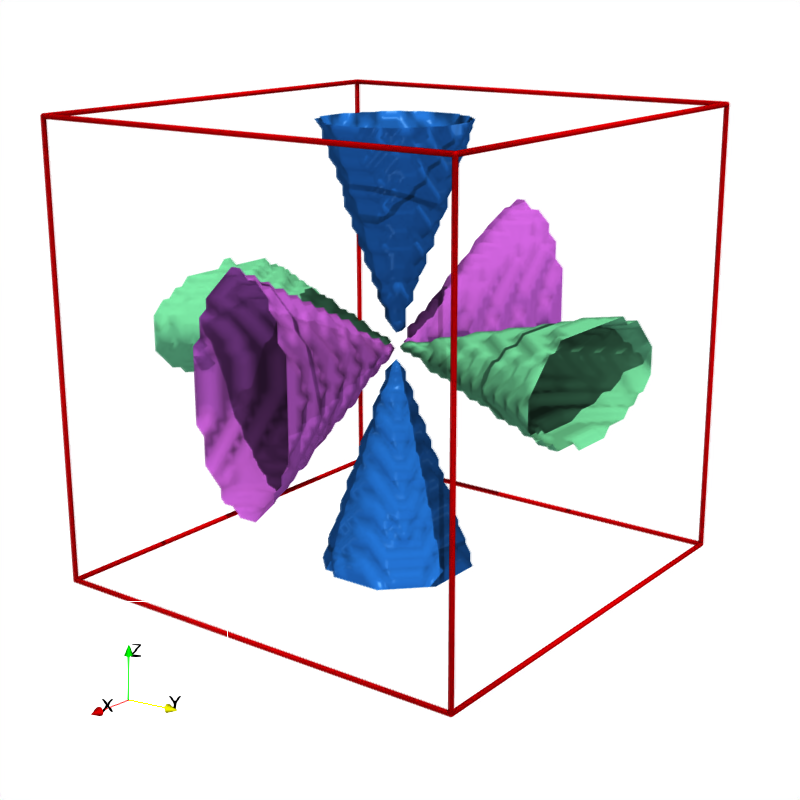
conex/coney/conez shapesCombining multiple transforms
transform accepts either a single map (one operation) or a sequence of maps, applied in listed order — the example below applies scale, then xrot/yrot/zrot, then translate. Available operations are scale: [sx,sy,sz], translate: [tx,ty,tz], xrot/yrot/zrot: <angle> (rotation around that axis) and plane: [Nx,Ny,Nz,D].
particle_regions:
  - CYL9:
      quadric:
        shape: cylz
        transform:
          - scale: [ 15 ang, 15 ang, 15 ang ]
          - xrot: pi/4
          - yrot: pi/3
          - zrot: pi/6
          - translate: [ 85 ang, 85 ang, 0 ang ]
Providing the raw quadric matrix directly
Instead of a named shape, quadric also accepts a matrix key: the 16 row-major coefficients of the quadric's symmetric 4×4 matrix \(Q\), evaluated as \(\mathbf{r}^T Q \mathbf{r} \le 0\) with \(\mathbf{r} = (x,y,z,1)\). matrix and shape are mutually exclusive — exactly one of the two must be given — but transform still applies on top of either.
The example below spells out the same unit-sphere quadric that shape: sphere produces internally, transformed exactly like the S1 region in Ellipsoid-quadrics above:
particle_regions:
  - S4:
      quadric:
        matrix: [ 1, 0, 0, 0,
                  0, 1, 0, 0,
                  0, 0, 1, 0,
                  0, 0, 0, -1 ]
        transform:
          - scale: [ 20, 20, 20 ]
          - translate: [ 45, 75, 70 ]
Use matrix directly when you need a quadric shape that isn't one of the named shape keywords — e.g. a general ellipsoid or hyperboloid expressed by its own coefficients — rather than one of sphere/conex/cylz/etc.
Range of particle ids
id_range: [start, end] selects particles whose id i satisfies start <= i < end (the upper bound is exclusive):