Bending potentials
A bending type is defined by a triplet of atom types, a functional form and the corresponding parameters values. The order of the atom types correspond to the numerical order of the figure.

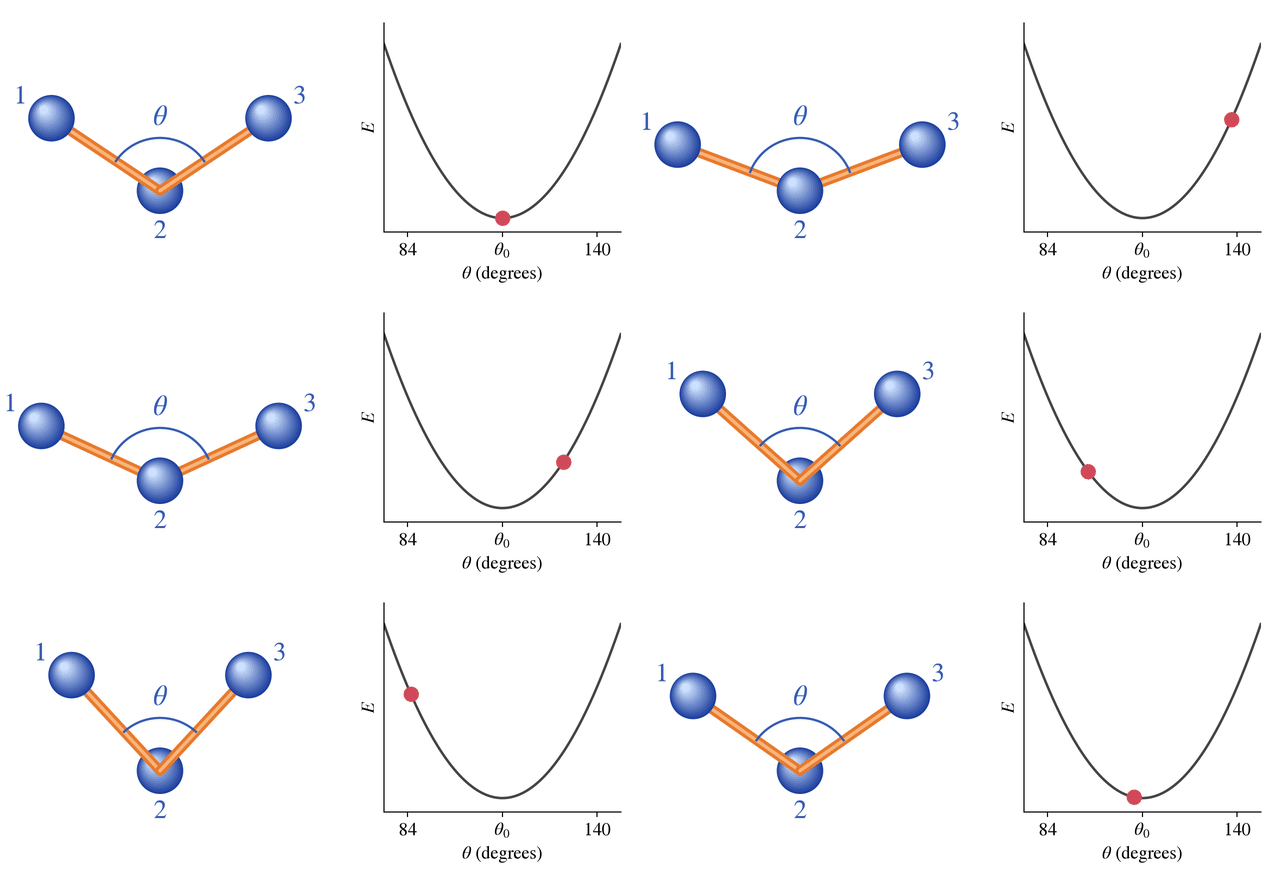
The bending angle \(\theta\) is defined by:
\[
\theta = \arccos{\frac{\mathbf{r}_{21}\cdot \mathbf{r}_{23}}{r_{21}r_{23}}}
\]
The angle is computed as \(\theta = \operatorname{atan2}(\lVert \mathbf{r}_{21}\times\mathbf{r}_{23}\rVert, \mathbf{r}_{21}\cdot\mathbf{r}_{23})\), which gives the same value but stays accurate close to 0 and 180 degrees. Linear (or almost linear) angles are allowed: the force is then computed with \(\sin\theta\) bounded below by \(10^{-3}\).
The following types of bending potentials are defined in exastamp: